


Hunting Wild Birds & NAVHDA Testing: How We Evaluate and Breed Better GSPs

Updated: Feb 26
A Prairie Fire Kennels Perspective
At Prairie Fire Kennels, our passion centers around breeding and developing German Shorthaired Pointers that excel as versatile upland gun dogs. We believe a truly great GSP should be able to transition seamlessly from prairie grasslands to timber thickets, from running roosters to tight-holding quail, and perform with intensity, intelligence, and composure in every environment.
Upland bird hunting isn’t just something we do — it shapes how we evaluate genetics, temperament, nose, drive, and trainability in our dogs. The species we pursue matter, because each one tests a different quality in a GSP.
From hard-running pheasants to explosive coveys of bobwhite quail, from sharp-tails in big, open country to ruffed grouse and woodcock in the tight cover of the Northwoods, these birds reveal what a dog is truly made of.
Here’s why I love hunting each of these species behind my GSPs — and what they teach me about great bird dogs every season.
Pheasants

If there’s a king of Midwestern upland birds, it’s the pheasant.
I've always joked that pheasants are hatched wearing running shoes. A rooster’s first instinct isn’t to sit tight — it’s to put ground between himself and danger. They’ll hit the dirt running, slip through grass, cut through cattails, and use every bit of cover to their advantage.
They’re challenging. They’re unforgiving. And when they do flush, that distinct cackle echoing across a field is unmistakable.
That’s what makes hunting them behind well bred GSPs so rewarding.
A good dog learns quickly that a pinned rooster is earned, not given. Pressure builds, scent shifts, and the dog must adjust constantly. I love watching a seasoned dog track with purpose — head up when scent is strong, nose down when the bird is moving. They’ll relocate cautiously, read the wind, and when everything finally comes together, slam into a hard, stylish point.
And when a rooster is hit but not anchored, the real test of a bird dog's nose begins.
A wounded running rooster demands a dog with a true nose for tracking. This is where a GSP’s versatility shines. A dog that can transition from pointing to determined ground tracking — sorting out a moving scent line through thick cover — is invaluable. Recovering those birds isn’t just satisfying, it’s part of ethical hunting.
There’s nothing quite like the cackle of a flushing rooster over a locked-up dog… unless it’s watching your GSP push through heavy cover, or cross a swift moving creek, and come back with a hard-earned retrieve.
Bobwhite Quail

If pheasants are chess, bobwhites are poetry.
Few scenes in upland hunting rival a staunch GSP locked up on a covey of bobwhites. The tension builds as you walk in, knowing at any moment the ground may erupt in a thunder of wings — like a covey of big bumble bees exploding in every direction.
Bobwhites teach steadiness and manners — in both dogs and hunters. They generally hold well for a properly handled dog, but they demand respect. Crowd them or rush in carelessly and they’ll prove how quickly opportunity disappears.
What I love most about bobwhites is what happens after the covey rise.
Once the birds scatter, the real fun begins. Singles often sit tight but can reposition quietly. A good dog learns to shift gears — slowing down, working objectives carefully, and trusting its nose instead of relying on speed alone. This is where maturity shows. Dogs that learn to handle singles with patience and composure become incredibly polished bird dogs.
There’s a rhythm to quail hunting — point, flush, scatter, regroup, work singles — and watching a dog learn that rhythm is incredibly rewarding.
Sharp-tailed Grouse

Sharp-tails are prairie birds through and through — big country, big casts, and big sky.
This is the kind of country GSPs were made for. They can stretch out, run with purpose, and use the wind intelligently. Watching a dog crest a rise hundreds of yards out and lock up against an endless prairie backdrop is something that never gets old.
Early season sharp-tails often hold well, making them excellent birds for young dogs to build confidence. As pressure increases, they grow wary — running ridgelines, using terrain to escape, and flushing wild if mishandled.
Sharp-tails teach dogs to think in big country. They learn to work into the wind, use coulees and draws strategically, and approach objectives with purpose rather than recklessness.
It’s a hunt that feels wild and expansive — highlighting a GSP’s endurance, independence, and cooperation all at once.
Preferred shot size: #6 lead
Grey Partridge (Hungarian Partridge)

Huns are fast and at times unpredictable — and they are, without question, my favorite upland bird to hunt.
When a covey rises over a staunch point, it happens in a blur — wings whirring, birds scattering low and fast across the prairie. The sound, the speed, the chaos — it’s pure adrenaline. If you’re not ready, the opportunity is gone just as quickly as it appeared.
They can be challenging and downright unforgiving. One day a covey will sit beautifully for a well-handled dog. The next, they’ll blow out at the edge of gun range without warning. That inconsistency is part of what makes them so addictive.
But what really makes Huns special to me is what they reveal in a dog.
Huns demand respect. Like ruffed grouse, they do not tolerate sloppy dog work. They require an incredible nose — as scent can get thin in dry prairie air. A dog must sort through ground scent, drifting scent, and wind changes to pin down a covey of Huns successfully.
Most of all, Huns highlight natural instinct. A well-bred GSP knows when to reach out across open country and apply pressure carefully. They learn to use terrain, work into the wind, and relocate with composure instead of recklessness. You can train obedience — but you can’t manufacture that kind of instinct.
When it all comes together — big prairie country, a hard point, and a covey exploding at your feet — it showcases everything I value in a versatile upland dog.
For me, there’s no better bird to watch a GSP do what it was born to do.
Preferred shot size: #6 lead
Sage Grouse

Sage grouse hunting is about patience, endurance, and respect for big landscapes.
The country is vast and rugged. Covering ground takes effort, and dogs need both athleticism and mental stamina to handle the miles.
But just as important as endurance is composure.
Sage grouse often hold well early in the season, offering beautiful, textbook points. Their size alone commands respect. When a dog locks up on a sage grouse in a sea of sagebrush, it’s an impressive sight.
What always amazes me is how those dogs can scent a sage grouse in what feels like an endless ocean of sage — when all my nostrils can smell is the overpowering scent of crushed sagebrush underfoot. To a human, the air seems saturated with one dominant smell. But a well-bred GSP can separate that bird scent from everything else, lock onto it, and follow it with confidence. It’s a reminder of just how incredible their noses truly are.
Because they are large birds, clean and ethical shot placement is critical. This isn’t rushed shooting — it’s deliberate and thoughtful. Sage grouse hunts feel serious, almost solemn at times, and they demand discipline from both dog and hunter.
For young dogs, sage grouse build confidence. For seasoned dogs, they reinforce steadiness and trust in wide-open country.
There’s something humbling about standing in that big sage landscape behind a dog on point — especially knowing they’re smelling something other than sagebrush.
Preferred shot size: #5 lead
Ruffed Grouse

Ruffed grouse are the ultimate test.
They live in tight, tangled cover — alder thickets, aspen cuts, and creek bottoms — where visibility is limited and opportunities are fleeting. Unlike prairie birds, this is intimate, close-quarters hunting. Everything happens fast.
GSPs that excel in grouse woods learn to shorten their range and adjust their pace naturally. They must trust their nose in damp, swirling timber air and stay mentally composed when scenting birds that rarely cooperate.
Ruffs can hold tight one moment and flush explosively the next. Their takeoff is sudden, loud, and often startling. Shots are measured in split seconds and narrow shooting lanes through branches. It’s not just a test of shooting — it’s a test of focus, control, and trust between dog and handler.
When a dog handles ruffed grouse well, you see instinct and adaptability on full display. They learn to hunt with intention instead of speed, to stay connected in heavy cover, and to maintain intensity without losing control.
When a dog can shift from wide-open prairie to thick northern timber and adjust seamlessly, you truly see the depth of the breed’s versatility.
Woodcock
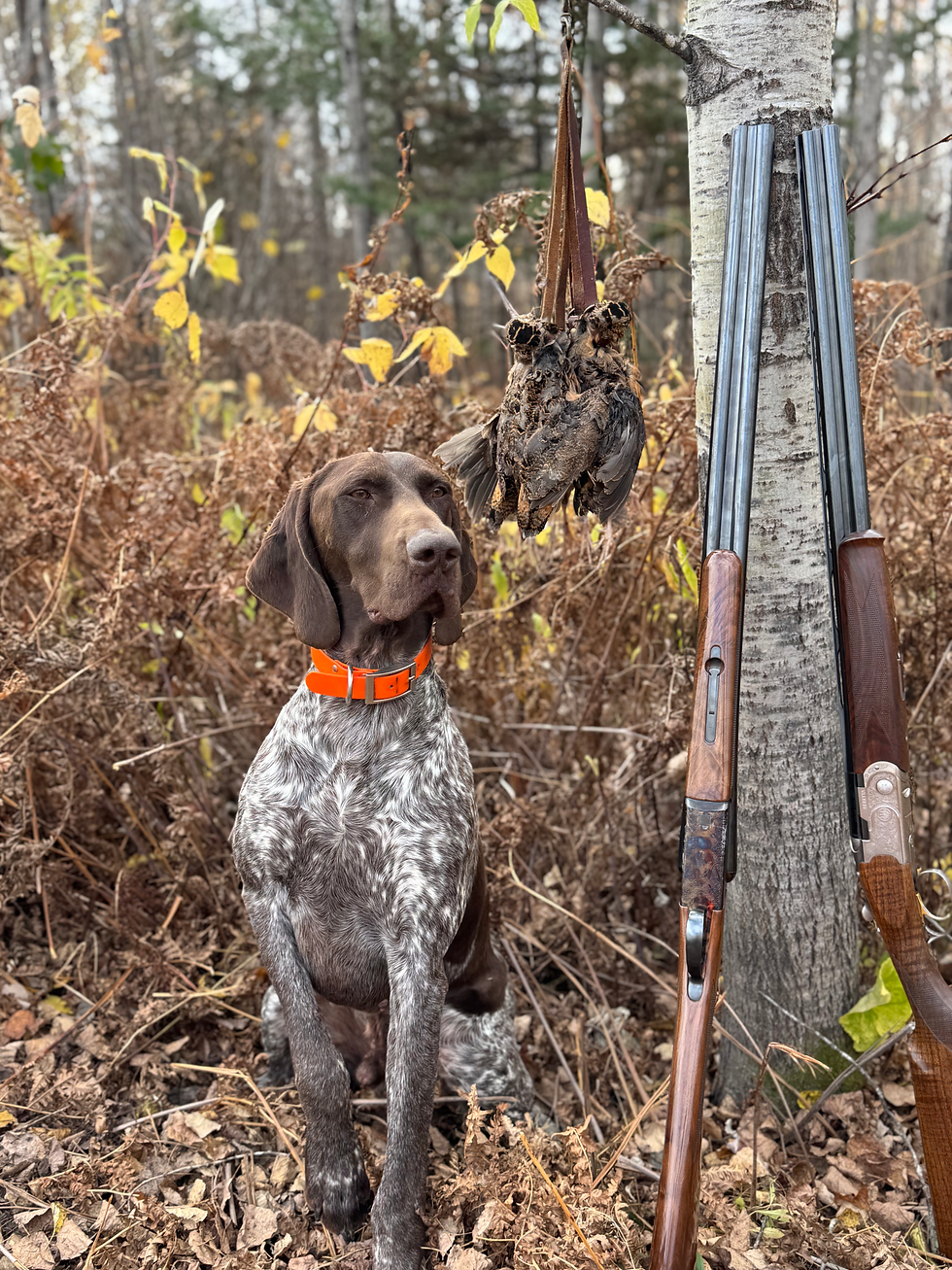
If ruffed grouse are unpredictable, woodcock are cooperative — but uniquely charming.
They favor moist young timber and creek bottoms and often hold remarkably tight. That makes them excellent birds for developing young dogs.
Woodcock reward nose work more than speed. Dogs learn to hunt methodically and stay connected. It’s a quieter, more deliberate style of hunting.
Their fluttering, twisting flight can still challenge even experienced wingshooters, especially in the golden light of a fall evening.
Woodcock remind you to slow down and enjoy the moment.
Preferred shot size: #8 lead
Why German Shorthaired Pointers Make It All Possible
The common thread across all these species is versatility.
GSPs have the range for prairie birds, the nose for running pheasants, the composure for quail and Huns, and the adaptability for tight-cover grouse and woodcock. Few breeds transition as seamlessly across landscapes.
That versatility is exactly what we strive to preserve and develop at Prairie Fire Kennels.
We value dogs that can think, adjust, and handle whatever bird country you drop them into. The birds we hunt shape how we evaluate our breeding program and measure success in the field.
And while I love the species I currently chase, there are still a few on my bucket list — Scaled Quail, Gambel’s Quail, Mearns (Montezuma) Quail, and Valley Quail. Each one represents new terrain, new challenges, and new lessons. It’s about seeing new country. Learning how to find and effectively hunt each species. And maybe most rewarding of all, watching my dogs adapt, grow, and ultimately master a completely new game.
But hunting alone doesn’t tell the whole story — and neither does testing.
That’s why NAVHDA testing and hunting upland birds go hand in hand for us at Prairie Fire Kennels. Hunting shows us how a GSP applies its natural instincts in real-world situations — changing wind, pressured birds, long days, and unpredictable conditions. NAVHDA testing provides a structured, objective evaluation of those same traits: nose, search, pointing instinct, cooperation, water work, and trainability.
By doing both, we gain a clearer picture of what our dogs truly are. Testing sharpens training. Hunting reveals heart. Together, they make us better breeders, better trainers, and ultimately more successful in the field.
Because at Prairie Fire Kennels, it’s never just about adding species to a list.
It’s about building versatile, driven, intelligent GSPs — and proving their ability both in the testing field and in wild bird country.
And that moment when your GSP locks up — tail high, body rigid, eyes forward — whether it’s on a familiar rooster or a brand-new species in unfamiliar country…
That never gets old.


Comments